De’Longhi Espresso Machine Leaking Water Underneath

Water under a De'Longhi is most often a full tray rather than a leak. Bean-to-cup models have an internal condensate tray as well as the visible drip tray, and it fills without warning. Empty both, then check the water tank seating and the brew unit seals before assuming a fault.
Causes, most likely first
Work down this list in order. The first two cost nothing to check.
- Drip tray full - the float indicator is easy to overlook
- Internal condensate tray on bean-to-cup models, which has no float at all
- Water tank not seated squarely, so the outlet valve does not engage
- Brew unit seals dried out or scaled on Magnifica and Dinamica models
- Scale causing a seal to weep under pressure
The fix, step by step
-
Empty the visible drip tray
Check the float. On most models a red indicator rises through the grid when it needs emptying.
-
Open the service door
On bean-to-cup models there is a second tray inside that collects condensate and brew unit drips. It has no float and nobody empties it.
-
Reseat the water tank
Lift it out and push it back firmly. A tank that is not fully home leaks at the outlet valve and looks like an internal fault.
-
Dry and towel test
Dry everything, lay a paper towel and run one cycle. Note where it wets first and whether it happens while pumping or at rest.
-
Pull the brew unit
On Magnifica and Dinamica models the brew unit comes out. Rinse it under warm water, let it dry, and check the seals are supple rather than hard.
-
Descale if it weeps under pressure
Scale on a seal face stops it sealing. A full cycle with the tank at MAX for the last two rinses is the documented procedure.
De’Longhi machines collect water in more places than people realise, and on the bean-to-cup models one of those places gives you no warning at all.
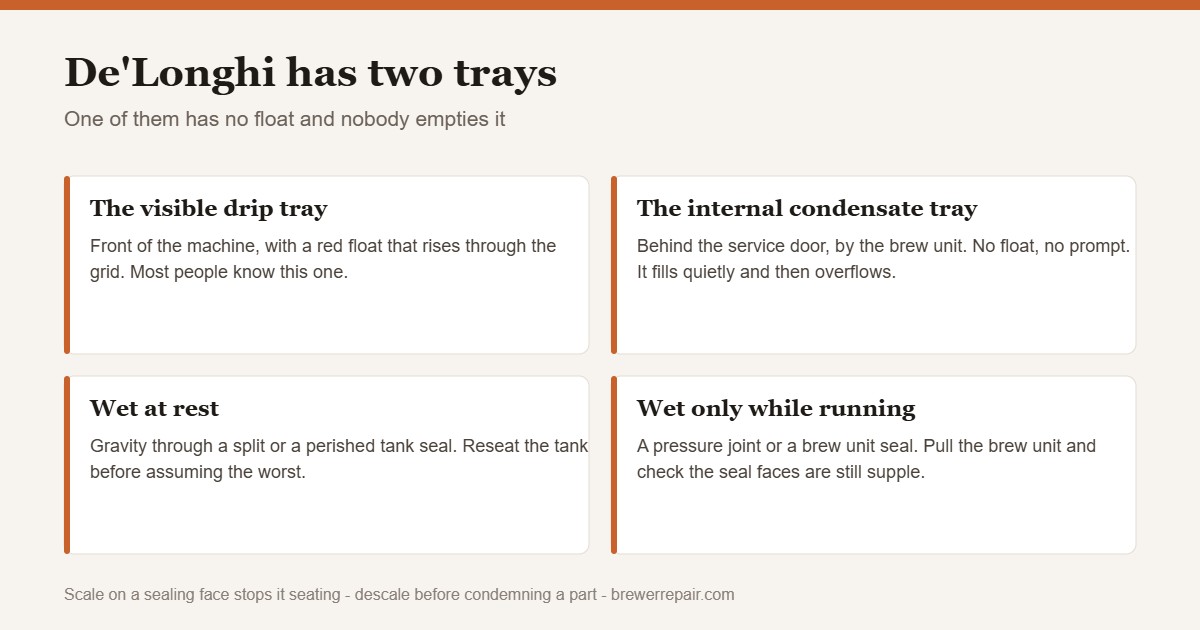
There are two trays
The visible drip tray at the front has a float – a red indicator that rises through the grid when it is time to empty it. Most people know about that one.
Bean-to-cup models also have an internal condensate tray behind the service door, in the brew unit area. It collects condensate and the drips that come off the brew unit at the end of a cycle. It has no float, no indicator and no prompt, so it fills quietly over weeks and then overflows onto the counter.
If your machine is a Magnifica, Dinamica or similar and you have never opened the service door, open it now. This is the answer more often than anything else on this page.
Reseat the tank
A water tank that has not been pushed fully home does not engage its outlet valve, and the resulting leak looks like something internal has failed. Lift it out and put it back deliberately. This is a common cause immediately after cleaning.
The towel test
Dry everything, lay a paper towel flat underneath, and run one cycle. What matters is the timing. Wet at rest means gravity through a split or a perished tank seal. Wet only while the machine runs means a pressure joint or a brew unit seal, because those only see pressure during a cycle.
The brew unit
On Magnifica and Dinamica machines the brew unit removes for cleaning, and its seals are a genuine leak source once they harden or scale over. Rinse it under warm water, let it dry properly, and look at the seal faces – supple is fine, hard and shiny is not.
When descaling helps
Scale deposited on a sealing face stops it seating, and the joint weeps under pressure. Descaling clears that and it is worth doing before condemning any part. It will not rescue a seal that has gone hard with age.
Related
What the descale cycle needs covers solution and the rinse step – including De’Longhi’s own reason a descale light will not clear. If the machine is signalling as well as leaking, what each light pattern means has the official answers.
If you need the part
Check the fitment chart against your model number before ordering — sizes that look identical often are not.

The part you need
De’Longhi Descaler: EcoDecalk and What the Cycle Misses
Paid link. We earn a commission if you buy — the guides stay free.
Questions people ask about this fix
Why is my De'Longhi leaking water underneath?
Most often a full tray. Bean-to-cup De'Longhi machines have two - the visible drip tray with a float, and an internal condensate tray behind the service door that has no float and gets forgotten entirely.
Where is the internal tray on a Magnifica?
Behind the service door on the side, in the same area as the brew unit. It collects condensate and brew unit drips. Because there is no indicator, it simply fills until it overflows.
My De'Longhi leaks only when it is brewing. What does that mean?
The leak is at a pressure joint or a brew unit seal rather than a tank or tray, because those parts only see pressure during a cycle. Pull the brew unit, rinse it and check whether the seals are still supple.
Can descaling stop a leak?
Sometimes. Scale deposited on a seal face stops it seating cleanly and it weeps under pressure. Descaling clears that. It will not repair a seal that has hardened with age.
The tray is empty and it still leaks. What now?
Reseat the water tank, then run the towel test to establish whether it leaks at rest or only under pressure. At rest points at the tank or a split; under pressure points at the brew unit or a hose joint.
Other De'Longhi problems
De’Longhi Milk Frother Not Working: Blocked, Not Broken
Milk dries into a hard plug inside the frother path within hours. Almost every frother that has stopped working is blocked rather than faulty.
De’Longhi Espresso Machine Not Pumping Water
A De'Longhi that has run dry needs priming, not repairing. The order to work through before concluding the pump has failed.