Keurig Descaling Solution: Which One, How Much, and What It Will Not Fix

One bottle of descaling solution per descale, every 3-6 months. Keurig's own kit and any espresso-formulated descaler do the same chemical job - the difference is dose size and price, not effectiveness. Take the water filter out first.
Does it fit your machine?
Match your model number exactly — the code on the rating label, not the name on the front of the machine.
| Model | Notes |
|---|---|
| K-Classic, K-Select, K-Elite | Filter holder in the tank. Take the charcoal cartridge out before you start. |
| K-Duo and K-Duo Plus | Two outlets off one pump. Solution must go through the pod side and the carafe side. |
| K-Slim and K-Slim + ICED | No filter holder, smaller tank. Expect more refills to finish the rinse. |
| K-Supreme and K-Supreme Plus | MultiStream needles restrict early. Keep to the short end of the interval. |
| K-Mini and K-Mini Plus | Single-cup tank. Mix part of the bottle rather than trying to fit it all in. |
| K-Cafe and K-Cafe SMART | Descale the brewer only. The frother is washed by hand, not descaled. |
| Keurig 2.0 (K200-K575) | Same solution. The prompt appears on the touchscreen instead of a light. |
Your model is not on this list. Do not assume it fits — send us the model number and we will check it.
OEM or aftermarket?
Keurig descaling solution is a mild food-safe acid sold in a small bottle, and one bottle is one descale. That is genuinely the whole product. The reason this is one of the most-searched things in the entire coffee category is not that the liquid is complicated — it is that people are standing at the machine with a lit descale light, unsure whether to buy the branded bottle, use the vinegar under the sink, or ignore it for another month.
Here is the short version: any espresso-formulated descaler will clear scale from a Keurig, Keurig’s own kit is worth buying mainly because it includes the filter and rinse pods you also need, and vinegar works but costs you rinse time instead of money.

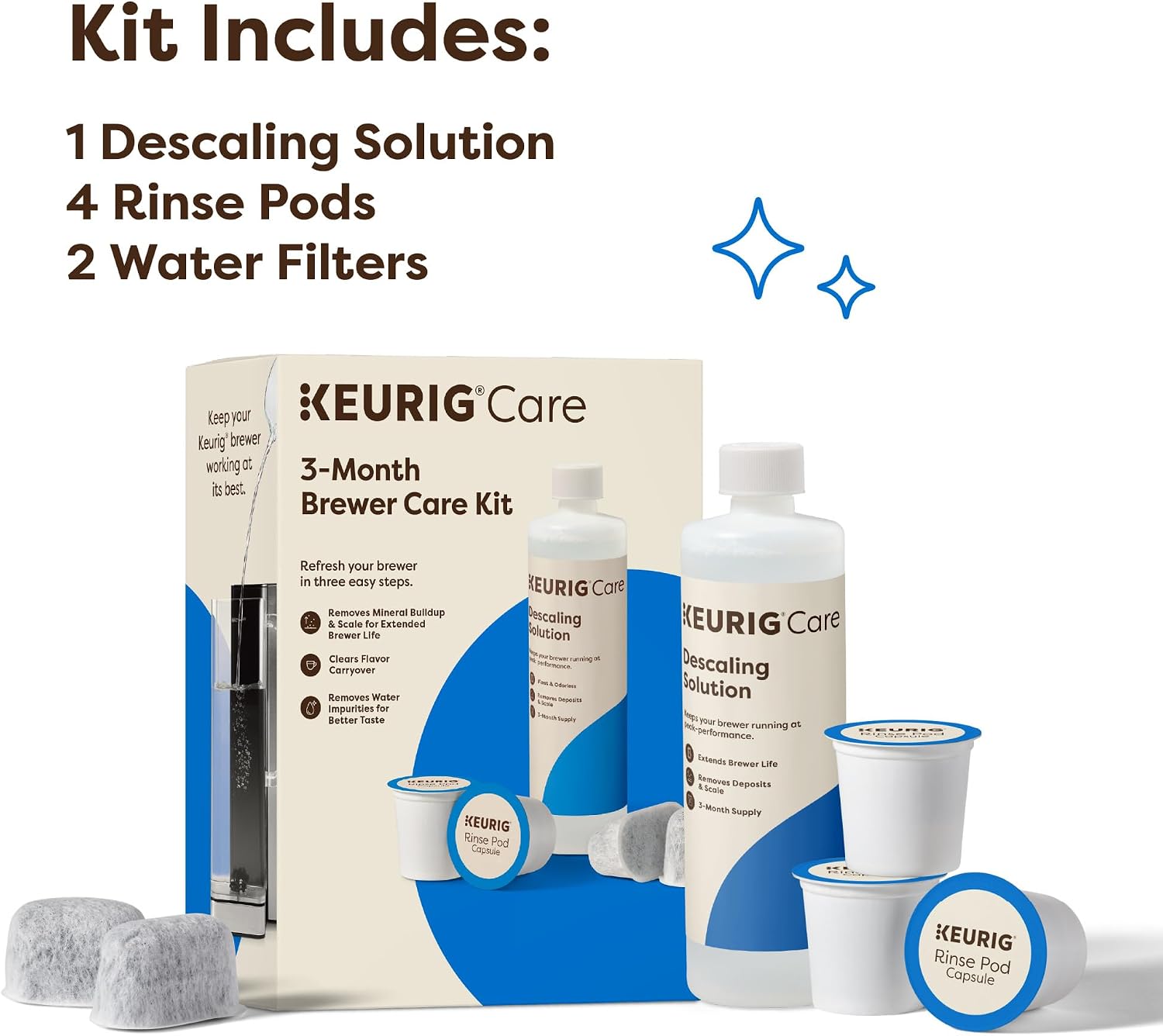
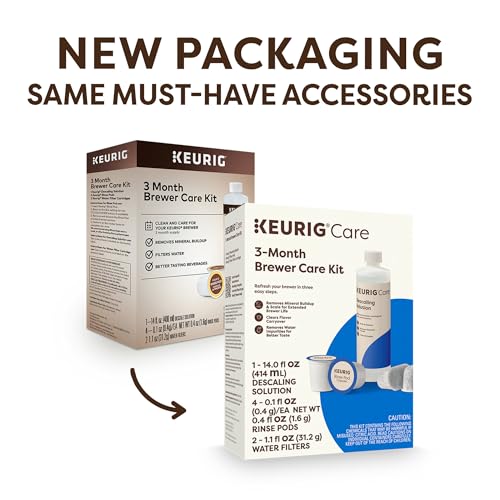
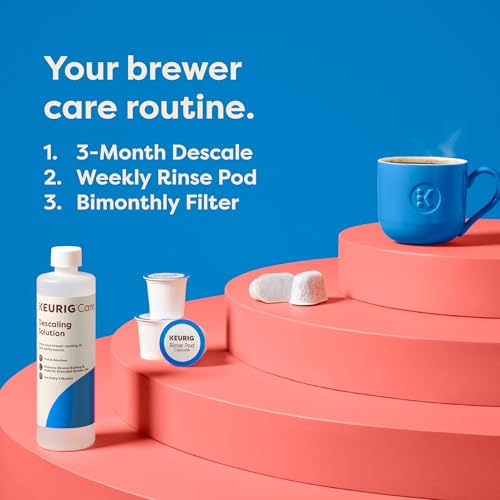
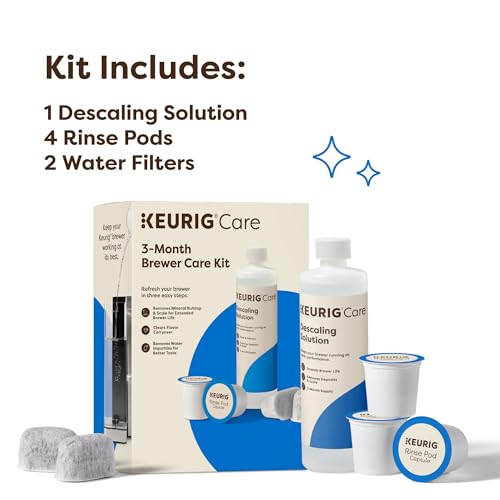
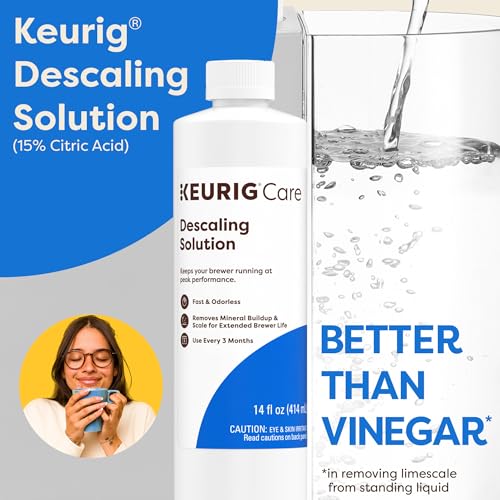
Prime Keurig 3-Month Brewer Maintenance Kit Includes Descaling Solution, Water Filter Cartridges & Rinse Pods, Compatible Classic/1.0 & 2.0 K-Cup Coffee Makers, 7 Count







As an Amazon Associate we earn from qualifying purchases. Product prices and availability are accurate as of the date/time indicated.
How much solution one descale takes
Treat the bottle label as the authority on dosing, because bottle sizes differ between brands. The standard method for a full-size brewer is to pour the entire bottle into an empty reservoir, then refill the empty bottle with fresh water and add that too. You are diluting roughly 1:1, and you want enough total volume to run several full cups through and still have liquid sitting in the lines.
The exception is the K-Mini and K-Mini Plus. Their tank holds a single cup, so a whole bottle will not fit. Use about half, top up to the fill line, run it through, and then run the rest as a second pass.
Solution or white vinegar
Both are acids doing the same chemical job on the same mineral deposit. The difference is what you pay with:
- Descaling solution — formulated for the seals and plastics used in brewers, rinses out in fewer cycles, no residual smell. $10–20 and it does one to several descales depending on the bottle.
- White vinegar at 1:1 — costs almost nothing and is already in the house. Needs at least one extra rinse tank, and if you cut the rinse short the next two or three cups taste of it.
What is not a trade-off: never mix the two, and never put bleach in a coffee machine under any circumstances.
Take the filter out first
If your model has a charcoal cartridge in the reservoir — the K-Classic, K-Select, K-Elite and most 2.0 brewers do — it comes out before you start. Descaler will exhaust a cartridge in one cycle, so running it through with the filter fitted wastes the filter and does nothing for the descale. A fresh cartridge goes in after the final rinse. The K-Slim and K-Mini have no filter holder, so there is nothing to remove.
What descaling will not fix
Descaler dissolves mineral scale in the water path. It does not touch coffee oils, and it does nothing at all for a blocked needle. This matters because a clogged entrance or exit needle produces exactly the same three symptoms as heavy scale: slow brewing, a short cup, and coffee that is no longer properly hot.
If a full descale and a proper rinse have not restored the flow, clear both needles with a needle cleaning tool before you conclude anything about the pump. It is a five-minute job and it fixes most of what is left.
How often, and how to tell you are late
Every three to six months is the working range. Water hardness moves that number far more than how many cups you pull:
- Soft water — six months is realistic.
- Moderately hard water — three to four months.
- Hard water — every two to three months, and the light will arrive sooner than that.
Rather than counting months, watch for the three signs the water path is already restricted: the brew takes noticeably longer than it used to, the coffee is not as hot, and the cup volume has quietly crept down. All three point at the same narrowing.
Running the cycle
The procedure differs by model, and one difference matters more than the rest: the K-Duo runs two outlets off one pump, so solution pushed through the pod side never touches the carafe side. Half-descaling a K-Duo is the single most common reason it is still slow afterwards.
Whichever model you have, the step people skip is the one that does the work: leave the solution standing in a warm machine for thirty minutes before you rinse. Descaling is a reaction that needs contact time, and water moving at brewing speed touches each surface for about a second.
If you own more than one machine, a universal descaler is cheaper per cycle than buying brand-specific bottles for each.
What to buy
Any of these will descale a Keurig. Prices move, so treat them as a guide rather than a quote.
Keurig 3-Month Brewer Maintenance Kit Includes Descaling Solution, Water Filter Cartridges & Rinse Pods, Compatible Classic/1.0 & 2.0 K-Cup Coffee Makers, 7 Count


12 Pack Keurig Filter Replacement by K&J - Compatible with Keurig Coffee Machine (2.0 and older)
Where to buy it
Keurig
Keurig Descaling Solution: Which One, How Much, and What It Will Not Fix
Paid link. Price shown is indicative — check the listing for the current price. We earn a commission at no extra cost to you.
Questions about this part
How much descaling solution does one Keurig need?
Treat the bottle label as the authority: the standard method is to empty the whole bottle into an empty reservoir, then refill the empty bottle with fresh water and pour that in too. On a K-Mini, where the tank holds a single cup, use roughly half and top up to the fill line - you will run the remainder as a second pass.
Can I just use vinegar?
Yes. White vinegar at 1:1 with water is the same class of acid and works. The trade is rinse time: vinegar needs at least one extra rinse tank before the coffee stops tasting of it. Solution is formulated for brewer seals and rinses out faster. Never mix the two, and never put bleach in a coffee machine.
Do I have to remove the water filter?
Yes, if your model has one. Descaler will exhaust a charcoal cartridge in a single cycle, so it comes out before you start and a fresh one goes in after the final rinse. The K-Slim and K-Mini have nowhere to fit one, so there is nothing to remove.
The descale light is still on after a full descale. Why?
On most Keurig brewers that light is a timer, not a scale sensor. It clears when the machine counts a completed cycle, so the usual cause is the reservoir running dry partway through and the brewer stopping early. Refill to MAX and run one complete cycle.
Is Keurig's own solution better than a universal descaler?
Not chemically - both are food-safe acids doing the same job, and a universal descaler is usually cheaper per descale. Keurig's kit is worth it if you also want the rinse pods and a replacement filter in the same box, which is most of what you need for a year of maintenance.
It is still slow after descaling. What now?
Then scale was not the whole problem. Coffee grounds in the entrance and exit needles produce exactly the same symptoms - slow brew, short cup, cooler coffee - and descaler does nothing to them. Clear both needles before you start suspecting the pump.
Repairs that need this part
How to Clean a Keurig K-Elite and K-Supreme
The K-Elite and K-Supreme sit at the top of the pod range and get used harder than the small models, which means they scale up faster…
Descaling a Keurig K-Slim: No Filter, Small Tank, Same Scale
The K-Slim has a narrow reservoir and no filter holder, which changes the descaling routine. How to run it and how many rinse tanks it actually needs.
Cleaning a Keurig K-Mini: No Reservoir, No Filter
The K-Mini has no removable tank, no water filter and no descale light. That changes how you clean it - here is the routine that actually applies.
How to Descale a Keurig K-Duo (and Clear the Light)
A step-by-step descale for the Keurig K-Duo, how often it actually needs doing, and what to do when the descale light will not clear.