Descaling a Breville Barista Express: Three Outlets, Not One

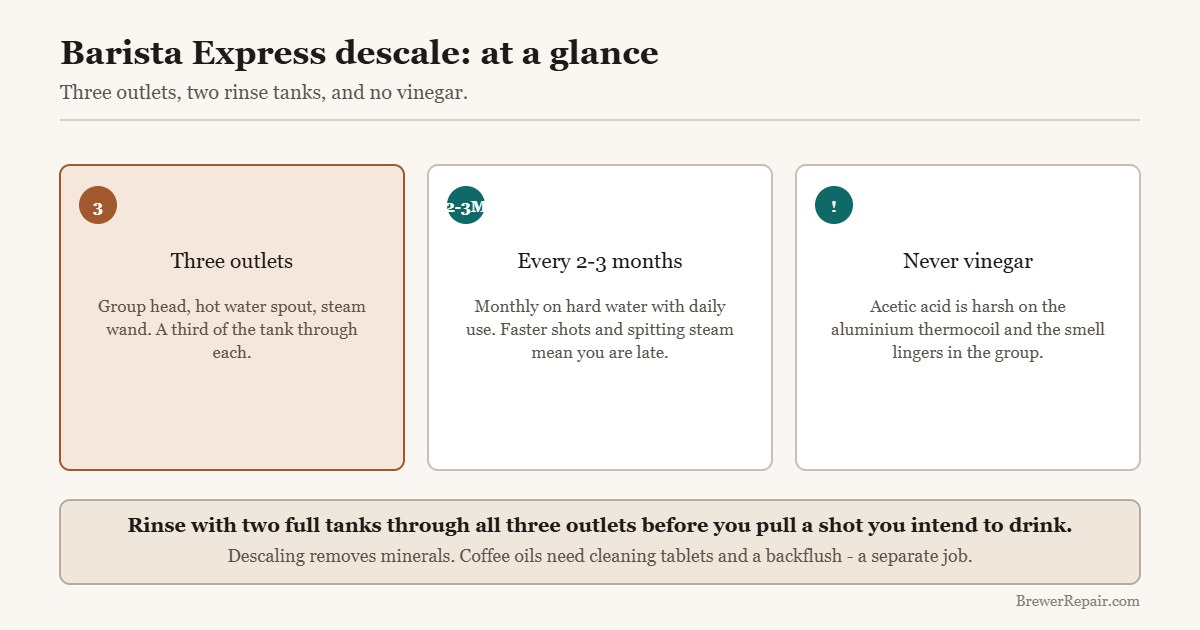
Run descaler through all three outlets - group head, hot water spout and steam wand - then rinse with two full tanks of clean water. Do not use vinegar in this machine.
What you need before you start

The part you need
Breville Descaler: Solution, Powder or Packets, and Which Your Machine Needs
Paid link. We earn a commission if you buy — the guides stay free.
Step by step
-
Strip the machine
Water filter out, drip tray emptied, portafilter removed.
-
Mix to concentration
Follow the bottle. Stronger is not better on an aluminium thermocoil.
-
Group head first
Run roughly a third of the tank through the group into a jug.
-
Hot water outlet
Another third through the hot water spout.
-
Steam wand last
Final third through the wand with the steam valve open. The step people skip.
-
Rinse twice
Two full tanks of clean water through all three outlets.
-
New filter
Fit a fresh cartridge, not the one you removed.
The mistake that makes people descale a Barista Express twice is treating it like a drip machine. A pod or filter brewer has one water path. A Barista Express has three outlets fed from the same thermocoil – the group head, the steam wand and the hot water spout – and scale forms in the shared path before it splits. Run solution through only the group and you have cleaned a third of the machine.
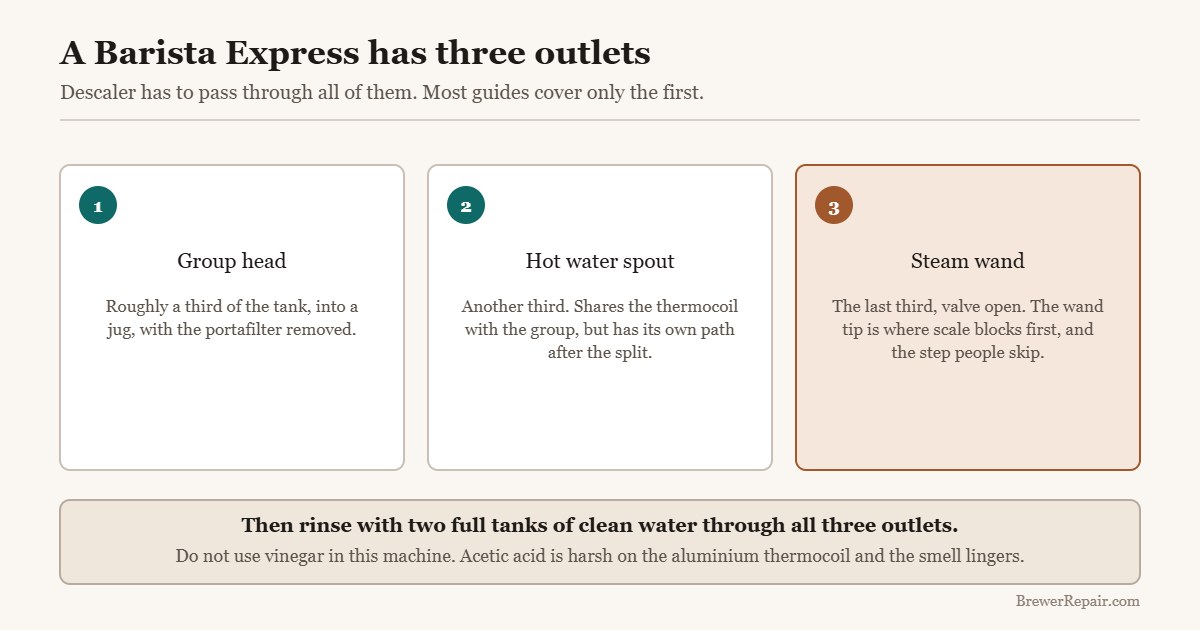
Descaler and filter:
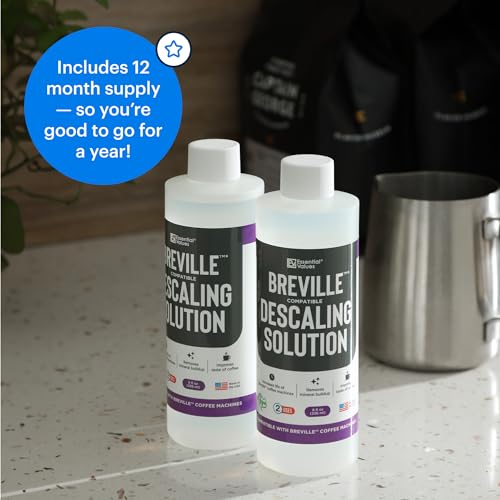
Prime Essential Values Descaling Solution Compatible with Breville, Coffee Pot Cleaner, Descaler Specially Formulated for Breville Coffee Machines,12 Month Supply, 2-Pack


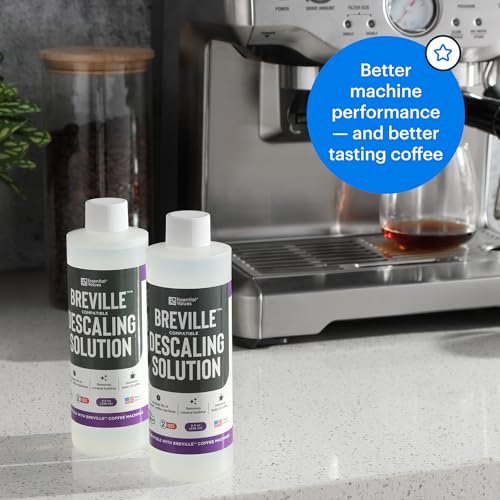
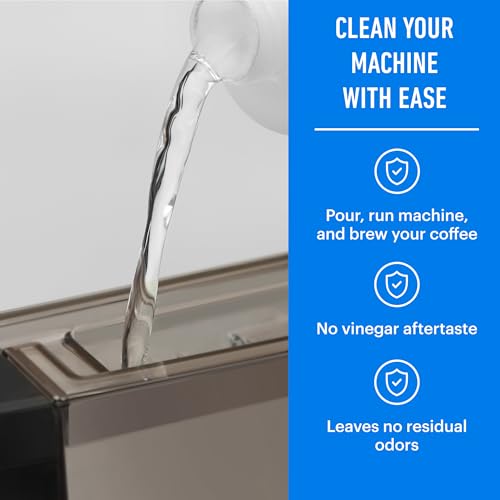
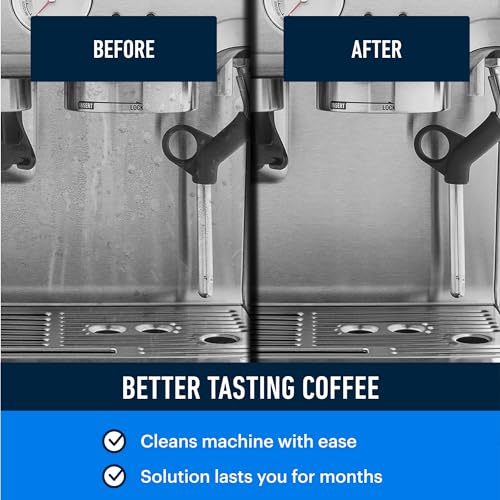
As an Amazon Associate we earn from qualifying purchases. Product prices and availability are accurate as of the date/time indicated.
How often
Every two to three months on typical water, monthly if you are in a hard-water area and pulling several shots a day. The machine’s own descale indicator is a usage counter rather than a scale sensor, so treat it as a reminder rather than a measurement. Two symptoms mean you are already overdue: shots that run faster than they used to at the same grind, and a steam wand that spits rather than delivering dry steam.
What to use
Use a descaler formulated for espresso machines. Breville sells its own; universal espresso descalers work. Do not use vinegar in this machine – the acetic acid is harsh on the aluminium thermocoil and the smell lingers in the group for a long time afterwards.
Take the water filter out of the tank first. Descaler exhausts a charcoal cartridge, and it is a false economy to leave it in.
The sequence
- Empty and prepare. Remove the water filter, empty the drip tray, and remove the portafilter.
- Mix the solution in the tank at the concentration on the bottle. Do not eyeball it – too strong is worse than too weak here.
- Run the group head. Put a large jug under the group and run water through until roughly a third of the tank has passed.
- Run the hot water outlet. Another third through the hot water spout.
- Run the steam wand. Open the steam valve and let the last third pass through the wand. This is the step almost everyone skips, and the wand is where scale blocks the tip first.
- Rinse, twice. Refill with clean water and repeat all three outlets. Then do it again. Two full tanks of clean water is the minimum before you pull a shot you intend to drink.
- Refit a fresh filter and run one more tank if you want to be certain.
What to buy
- Essential Values descaling solution for Breville – formulated for espresso machines, two descales per bottle.
- Universal espresso machine descaler – works across brands if you have more than one machine.
- Breville BWF100 charcoal water filters – fit a fresh one after every descale.
Avoid vinegar here, whatever it costs. On an aluminium thermocoil it is a false economy.
What descaling does not fix
Descaler dissolves mineral scale. It does nothing to coffee oils in the group, the shower screen or the baskets – that is a separate job with cleaning tablets and a backflush. And if the machine has stopped building pressure, look at grind, dose and the portafilter and basket before assuming scale.
Why three outlets and not one
A drip brewer has a single path: tank, heater, shower head, done. A Barista Express splits after the thermocoil into the group head, the hot water spout and the steam wand. Scale forms in the shared section first, but each branch then accumulates its own deposits at different rates depending on how you use the machine.
If you mostly pull shots and rarely steam, the wand still scales — it holds residual water between uses and that water evaporates, leaving minerals behind at the tip. That is why a machine that “only ever makes espresso” still ends up with a wand that spits.
Reading the machine instead of the calendar
The descale indicator counts shots, not scale. Three symptoms tell you the truth sooner:
- Shots running faster at an unchanged grind. Counter-intuitive but reliable: scale narrows the lines, pressure behind the puck drops, and the shot blondes early.
- Steam that spits water rather than delivering dry steam. Usually the first symptom, and the one people tolerate longest.
- A longer wait between switching on and the ready light. Scale insulates the thermocoil, so it takes longer to reach temperature.
Why not vinegar in this machine
The thermocoil is aluminium. Acetic acid attacks aluminium more aggressively than the citric and lactic acids used in proper descalers, and the effect is cumulative rather than dramatic — you will not see damage after one use, which is exactly why people keep doing it. The second problem is smell: vinegar lingers in the group and the silicone seals for far longer than in a plastic drip machine, and it comes through in the cup for days.
An espresso-specific descaler costs about the same as two bags of beans and lasts several cycles.
Descaling and backflushing are different jobs
Descaling removes minerals from the water path. Backflushing removes coffee oils from the group head, the shower screen and the three-way valve, using a blind basket and a detergent tablet. Neither touches the other’s problem.
The symptom split is useful: a machine that has lost pressure and flow is usually scaled; a machine whose shots taste dull, ashy or stale is usually full of old oil. If both are true, do both — descale first, then backflush, then rinse.
After the descale
Fit a fresh BWF100 cartridge and run one more tank of clean water before your first real shot. Then pull a shot and throw it away: the first one after any deep clean carries whatever is left in the group, and it is never worth drinking.
If the machine is still not building pressure after all of that, the problem was never scale. Run the blind basket test to separate a puck problem from a machine problem before spending anything.
Related on BrewerRepair: Breville Espresso Machine Not Building Pressure.
Descaler and filter for a Barista Express
Espresso-specific descaler, and a fresh BWF100 to fit afterwards. Not vinegar.
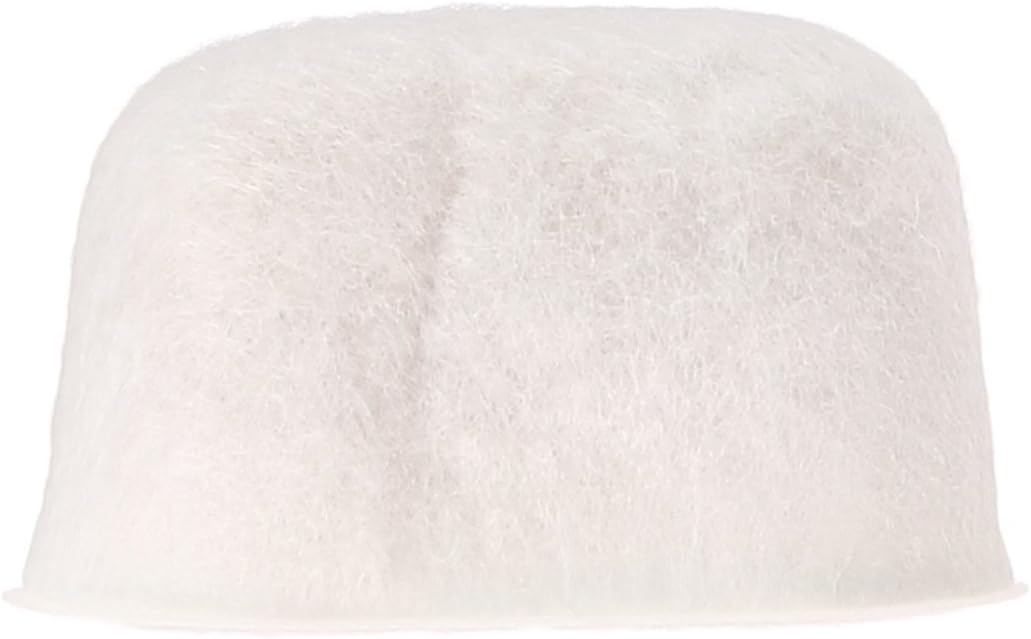
Breville BWF100 Charcoal Replacement Water Filters, 6 pack
Common questions
Can I use vinegar to descale a Breville Barista Express?
Better not to. Acetic acid is harsh on the aluminium thermocoil and the smell lingers in the group.
Do I really need to run the steam wand?
Yes. The wand tip is where scale blocks first, and group-only descaling leaves it untouched.
How often should a Barista Express be descaled?
Every two to three months, monthly on hard water with heavy use.
Descaling did not fix my weak shots. Why?
Weak shots are usually grind, dose or basket problems. Descaling addresses flow restriction, not extraction.
What happens if you skip it
These are the failures that scale causes, in the order we see them.
Breville Espresso Machine Leaking: Where to Look
Four places a Breville leaks, and the group head gasket accounts for most of them. How to tell it apart from an overfilled drip tray.
Breville Grinder Not Working: Jam, Residue or Motor
A Breville grinder that hums, stalls or produces nothing is nearly always jammed or gummed rather than broken. How to tell which, in order.
Breville Not Building Pressure: Puck First, Machine Second
A Breville that gushes and never reaches pressure is usually a grind and dose problem, not a pump fault. How to separate the two definitively.