Breville Descaler: Solution, Powder or Packets, and Which Your Machine Needs

Descaler for a Breville is sold as liquid, powder or single-dose packets. All three are the same class of acid and any of them clears scale. What actually matters on these machines is that the descale cycle runs solution through three outlets, not one, and that descaling is a different job from backflushing.
Does it fit your machine?
Match your model number exactly — the code on the rating label, not the name on the front of the machine.
| Model | Notes |
|---|---|
| Barista Express BES870 / BES870XL | BWF100 filter in the tank - remove it before descaling. |
| Barista Pro BES878 | Same cycle. Descale alert appears on the display. |
| Barista Touch BES880 | Same cycle, prompted on the touchscreen. |
| Infuser BES840 | Same solution, manual cycle. |
| Duo Temp Pro BES810 | No display - run the cycle on the calendar, not on a prompt. |
| Bambino / Bambino Plus BES450 / BES500 | Small tank. Mix a part dose rather than a full one. |
| Dual Boiler BES920 and Oracle | Two boilers. Both circuits need solution through them. |
Your model is not on this list. Do not assume it fits — send us the model number and we will check it.
OEM or aftermarket?
Search for a Breville descaler and you will find the same job sold under three different words: descaling solution, descaling powder, and descaler packets. People search all three in roughly equal numbers, which tells you nobody is sure whether they are different products. They are not. All three are a mild food-safe acid dosed for a pump espresso machine, and any of them will clear scale out of a Barista Express.
What actually matters on these machines is two things that have nothing to do with the format: the descale cycle has to reach three outlets rather than one, and descaling is a completely different job from backflushing.

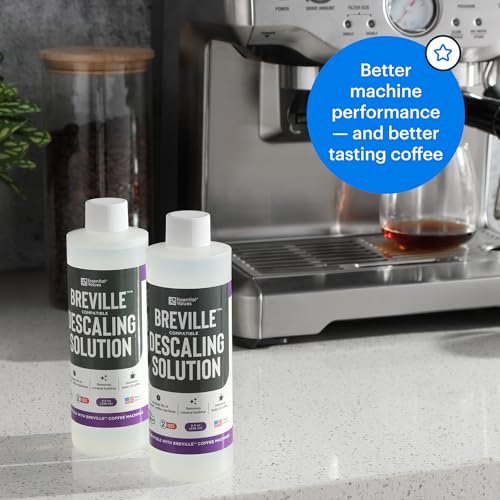
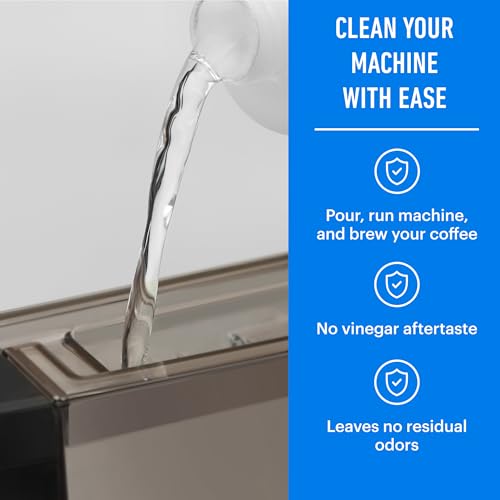
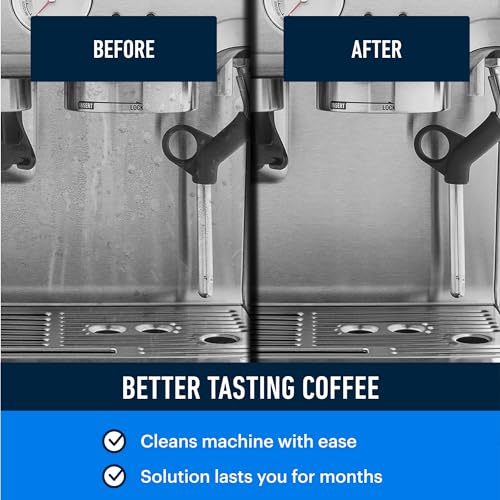
Prime Essential Values Descaling Solution Compatible with Breville, Coffee Pot Cleaner, Descaler Specially Formulated for Breville Coffee Machines,12 Month Supply, 2-Pack


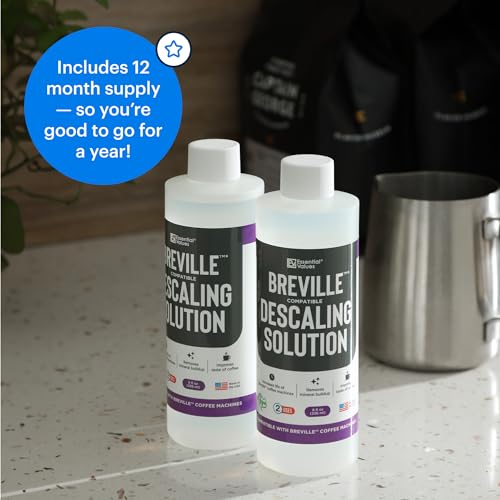
As an Amazon Associate we earn from qualifying purchases. Product prices and availability are accurate as of the date/time indicated.
Powder, packets or liquid
The format only changes how the dose is packaged. A single-use packet is one descale by definition, which makes it hard to get wrong. A bottle may hold two doses or twelve, so the cost per descale is the number worth comparing, not the price on the shelf.
Follow the dose printed on the pack you actually bought. Descaler concentrations differ between brands, and a dose you read on someone else’s bottle is not transferable.
Three outlets, not one
This is the Breville-specific part. A Barista Express and its relatives push water out of three places: the group head, the hot water spout, and the steam wand. They share a boiler and a pump, but after the split they are separate paths.
A descale cycle that only runs through the group head leaves scale sitting in the steam and hot-water circuits — which is why people descale, notice the shots improved, and then wonder why the steam wand still has no pressure. The full cycle for the Barista Express covers the order to run them in.
Descaling and backflushing are different jobs
Worth being blunt about, because it is the most common confusion on these machines:
- Descaling uses acid to dissolve mineral scale from the water circuit. Symptoms: slow flow, weak steam, coffee not properly hot.
- Backflushing pushes water backwards through the group head with a blind basket and a cleaning tablet to clear coffee oils. Symptoms: bitter, muddy-tasting shots and a dirty group.
Different deposit, different place, different chemical. Doing one does not do the other, and a machine that is overdue for both will not be fixed by descaling twice.
Take the water filter out first
If your model holds a BWF100 charcoal cartridge in the reservoir — Barista Express, Barista Pro and Precision Brewer do — it comes out before you start. Descaler exhausts a cartridge in a single cycle, so leaving it in wastes the filter and does nothing useful for the descale. Fit a fresh one after the final rinse, not the one you took out.
Why I would not use vinegar in this one
On a drip machine or a kettle, white vinegar at 1:1 is a perfectly reasonable descaler and I would not talk anyone out of it. A pump espresso machine is the exception. There are more seals in the path, a three-way solenoid valve, and a boiler that is aluminium or brass depending on the model. Vinegar is harsher on that path and much slower to rinse out of it, and unlike a drip machine you cannot simply run three tanks through and taste the result.
The saving is a few dollars. The thing you are risking is a group head gasket and a solenoid.
How often
Every two to three months on hard water, three to six on soft. Machines with a display will prompt you, but that prompt is a counter rather than a scale sensor — on genuinely hard water you will be due before the machine asks.
The reliable signals are in the cup and at the wand: shots pulling slower than they used to, steam pressure dropping off, and water that is no longer properly hot. If the shots have gone bitter rather than slow, that is oils and the answer is a backflush, not a descale.
What to buy
A descaler, a replacement filter and a tub of cleaning tablets between them cover a year of maintenance on a Barista Express. Prices move, so treat these as a guide.

Breville BWF100 Charcoal Replacement Water Filters, 6 pack

Where to buy it
Breville
Breville Descaler: Solution, Powder or Packets, and Which Your Machine Needs
Paid link. Price shown is indicative — check the listing for the current price. We earn a commission at no extra cost to you.
Questions about this part
Powder, packets or liquid - does it matter?
Not chemically. The three formats exist because manufacturers dose them differently: a packet is one descale, a bottle may be two or more. Buy on cost per descale rather than on the word on the label, and follow the dose on the pack you actually bought rather than a number you read somewhere else.
Can I use vinegar in a Breville espresso machine?
It is the one machine type where I would not. A pump espresso machine has more seals, an aluminium or brass boiler depending on model, and a three-way solenoid valve, and vinegar is harsher and much slower to rinse out of that path than a formulated descaler. On a drip machine or a kettle vinegar is fine. Here the saving is a few dollars against a rinse you cannot easily verify.
Is descaling the same as backflushing?
No, and this is the most useful thing to know about these machines. Descaling clears mineral scale from the water circuit with acid. Backflushing pushes water and a cleaning tablet backwards through the group head to clear coffee oils. They target different deposits in different places, and doing one does not do the other. Bitter coffee is usually oils; slow or cool coffee is usually scale.
Do I take the water filter out?
Yes. The BWF100 charcoal cartridge sits in the reservoir on the Barista Express, Barista Pro and Precision Brewer, and descaler exhausts it in one cycle. It comes out before you start and a fresh one goes in after the final rinse.
How often should a Breville be descaled?
Every two to three months on hard water, three to six on soft. Models with a display will tell you, but the prompt is a counter rather than a scale sensor, so on genuinely hard water you will be due before it asks. If shots are pulling slower or the steam wand has lost pressure, you are already late.
The descale alert will not clear.
Almost always an incomplete cycle. These machines count volume passing through, so a tank that ran dry partway stops the count. Refill to MAX and run the cycle through to the end, including the rinse phases.
Repairs that need this part
Descaling a Breville Barista Pro and Precision Brewer
These two Brevilles both tell you when descaling is due, and both are counting rather than measuring. The prompt is driven by how much water has…
Descaling a Breville Barista Express: Three Outlets, Not One
A Barista Express has a group head, a steam wand and a hot water outlet. Descaler has to go through all three, and most guides only cover the first.