Is a Keurig Worth Repairing? The Four-Fault Rule

A Keurig is worth repairing when the broken part is one you can buy and fit yourself — needles, reservoir, descaling. It is not worth repairing when the pump, heater or board has failed, because a paid repair costs more than most of the range does new.
The numbers
A Keurig is not one machine, it is a pump, a heater, a control board and a set of plastic parts that wear at different rates. “Is it worth repairing” has no single answer — it depends entirely on which of those has failed. Two faults are five-minute jobs that cost nothing. Two others end the machine.
This page splits them, with the numbers, so you can decide in about a minute instead of spending $30 on a part for a brewer that was finished anyway.
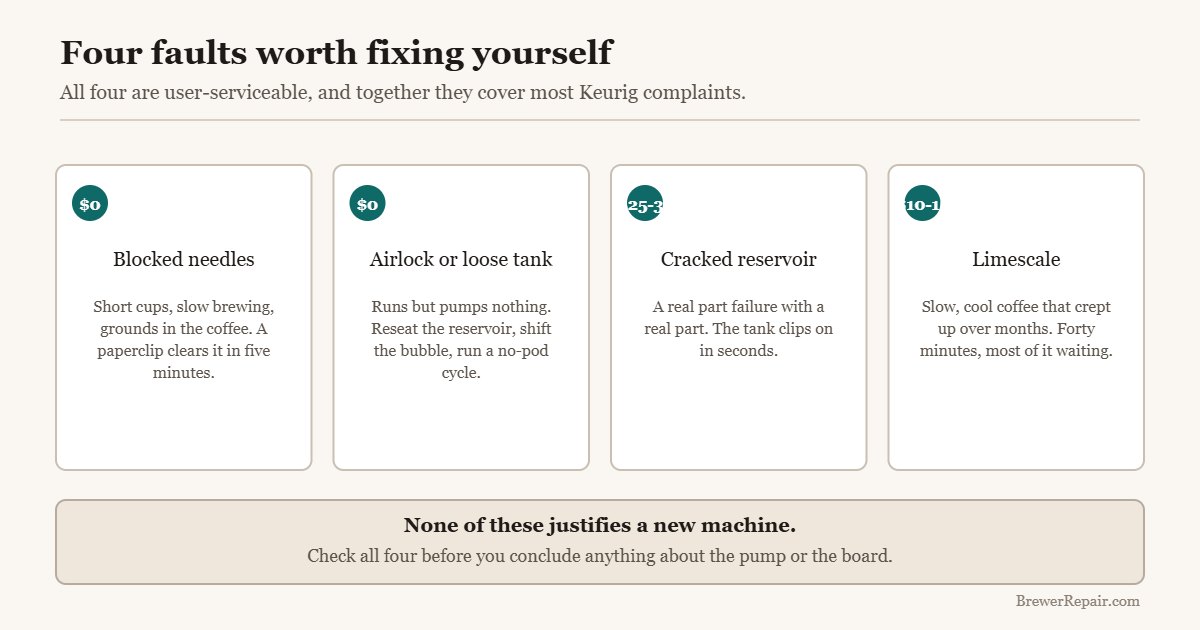
The faults that are worth fixing
All four of these are user-serviceable with no tools beyond a paperclip, and all four are common enough that they are worth checking before you conclude anything.
- Short cups, slow brewing, grounds in the coffee — blocked entrance or exit needle. $0 with a paperclip, about $10 for a proper needle tool. This is the single most common Keurig complaint and it is not a fault at all, it is maintenance.
- Runs but pumps nothing — usually an airlock or a reservoir that is not seated. $0. Work through the diagnosis in order before spending anything.
- Cracked or leaking reservoir — a genuine part failure with a genuine part. $25-37 for a replacement tank, and it clips on in seconds.
- Slow, cool coffee that has crept up over months — limescale. $10-15 of descaler and forty minutes, most of it waiting.
Between them, those four cover the large majority of Keurig problems people bring to a forum. None of them justifies a new machine.
The faults that end the machine
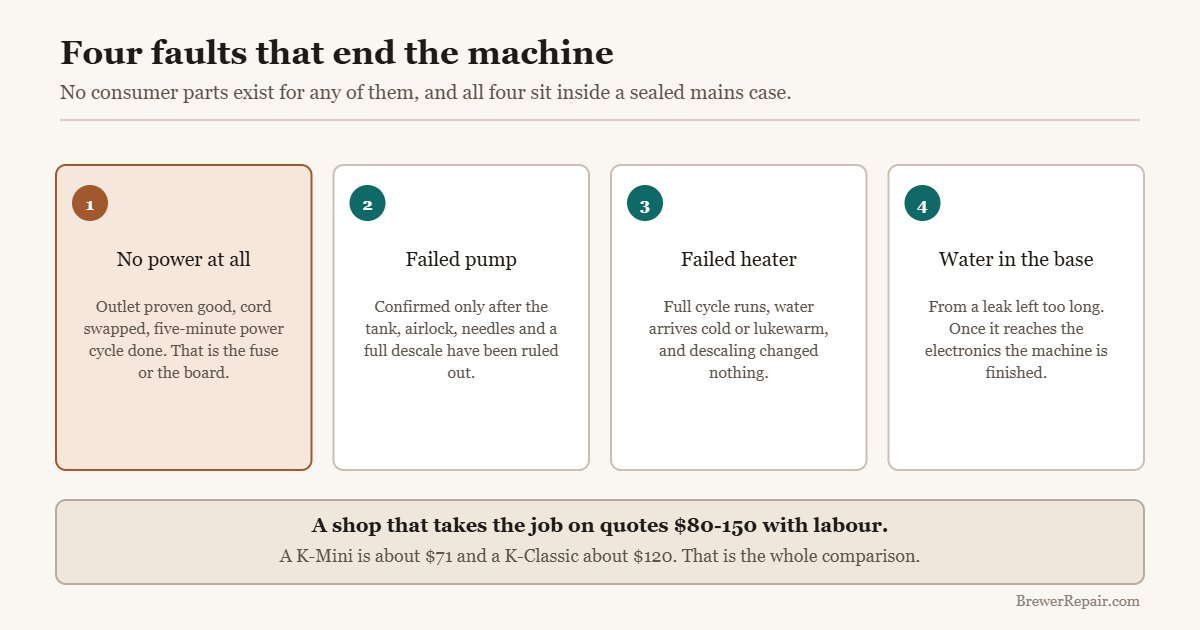
These are the ones where the arithmetic stops working:
- Will not power on at all — no lights, no sound, and the outlet is proven good with something else. That is the cord, the internal fuse or the control board, all inside a sealed mains-connected case.
- Pump has failed — confirmed only after the tank, the airlock, the needles and a full descale have been ruled out. Replacing it means opening the case and reaching a soldered assembly.
- Heater failure — the machine runs a full cycle and delivers cold or lukewarm water even after descaling.
- Water inside the base — from a leak that has been ignored. Once water has reached the electronics, the machine is finished regardless of what else works.
Keurig does not sell pumps, boards or heating elements as consumer parts, and no third party makes them. Independent repair shops that will take the job on quote in the region of $80-150 once labour is included — which is more than most of the range costs new.
Running the numbers
Here is the whole decision in one line: a Keurig is worth repairing when the broken part is one you can buy and fit yourself, and worth replacing when it is not.
The reason that rule works on this brand specifically is the price of the machines. A K-Mini is around $71 and a K-Classic around $120. Any repair that involves paying someone to open the case is competing against a brand-new brewer with a warranty, and it loses.
Two other factors move the line:
- Age. Under two years, check the warranty before anything else — Keurig’s own support replaces machines more readily than people expect. Over five years, a second fault usually follows the first within months.
- Which model. Spending $37 on a reservoir for a $50 K-Mini Mate is different from spending it on a $190 K-Café. The part cost is the same; the proportion is not.
Before you decide it is dead
Two minutes of checks that regularly rescue a machine people had already written off:
- Test the outlet with something else. A dead socket looks exactly like a dead brewer.
- Try a different cord if yours is detachable. Cords fail at the strain relief far more often than boards fail.
- Unplug for five minutes, then plug back in. Some models latch into an error state that a full power cycle clears. It costs nothing and it works often enough to be worth doing first.
- Check the tank is fully seated. Several models refuse to start a brew at all if the reservoir contact is not made.
If you are replacing, buy for the fault you had
The picks below are chosen on that basis rather than on features:
- If yours died of scale, get a model with a removable reservoir and a filter holder — descaling is easier and there is a consumable that reminds you to do it.
- If yours died of a cracked tank, the compact models with a fixed tank remove that failure mode entirely, at the cost of filling per cup.
- If you only ever brewed one size, the cheaper machines do that job identically. The price difference across the range is reservoir size and programmability, not brew quality.
What to do with the old machine
Do not put it in general waste. A pod brewer contains a pump, a heating element and a board, and most municipal recycling centres accept small appliances. Keurig has also run a recycling programme at various times — worth checking before it goes in a bin.
If the machine still powers on and only the pump has gone, the reservoir, lid, drip tray and pod holder are all worth keeping as spares if you are replacing with the same series.
If you're replacing — what we'd buy
Chosen for repairability first: published parts diagrams, common fittings, and pumps and gaskets you can actually source in five years.
Keurig
K-Mini
Fixed tank removes the cracked-reservoir failure mode entirely, and it is the cheapest sensible replacement.
Keurig
K-Express
Removable reservoir and filter holder, so descaling is easy and there is a consumable reminding you to do it.
Keurig
K-Classic
The most-reviewed machine in the range, with the widest parts availability if something does fail later.
Questions
Can you replace the pump in a Keurig?
Not as a consumer. Keurig does not sell pumps as parts and no third party makes them. A shop that takes the job on will quote $80-150 with labour, which is more than most of the range costs new.
My Keurig will not turn on at all. Is it dead?
Not necessarily. Test the outlet with another appliance, try a different cord if yours detaches, and unplug the machine for five minutes before concluding anything. If all three fail, it is the fuse or the board and it is finished.
Is it worth buying a replacement reservoir?
Yes on a full-size machine — $25-37 for a part that clips on in seconds. Think twice on a $50 compact model, where the part is most of the machine.
How long should a Keurig last?
Five years is typical with descaling, three without. After five years a second fault usually follows the first within months.
Does Keurig repair machines under warranty?
Their support replaces machines more readily than people expect within the warranty period. Check the date before spending anything.
Before you give up on it
Keurig Coffee Tastes Burnt or Bitter: What Causes It
Burnt and bitter are different complaints with different causes, and the plastic in a Keurig holds onto old coffee oil in a way people underestimate.
Clogged Keurig: Needle, Water Line or Scale
Three different blockages produce the same symptom. Which one you have decides whether the fix is two minutes with a paper clip or a full descale.
Keurig Leaking Water From the Bottom: Find the Source First
Water under a Keurig comes from four places and only one of them needs a part. The paper towel test tells you which before you spend anything.