Keurig Water Filters: Which Cartridge Fits and How Often

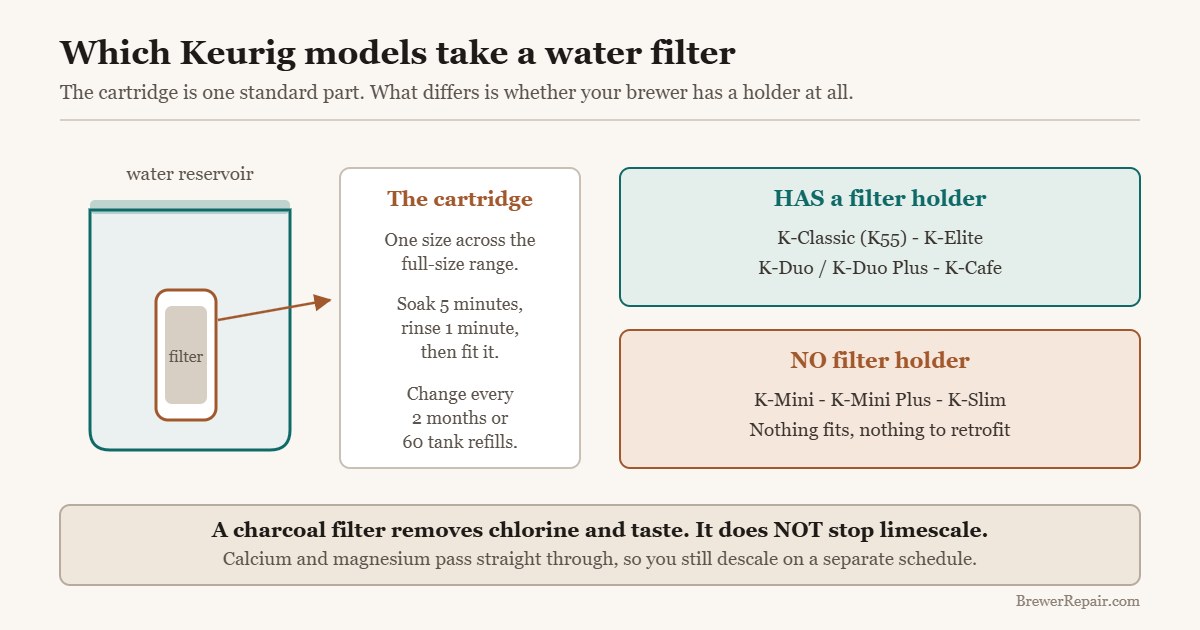
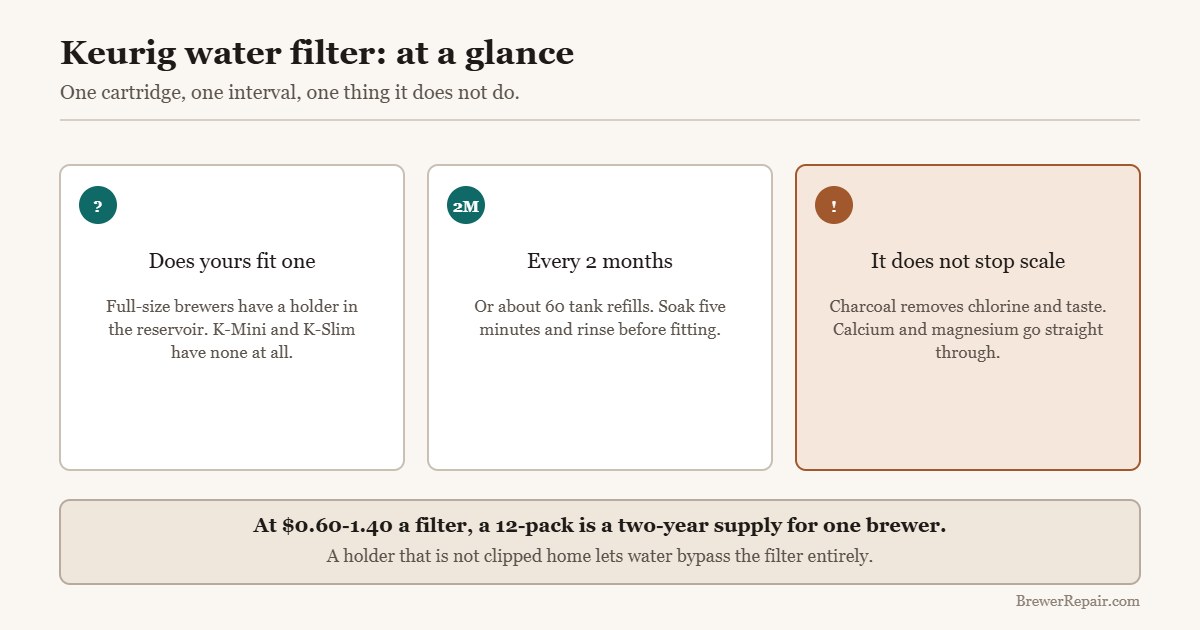
Every full-size Keurig with a filter holder uses the same standard charcoal cartridge. The K-Mini, K-Mini Plus and K-Slim have no holder at all, so no water filter fits them.
Also sold as: Sold by K&J Pureline Possiave and others as 6 or 12 packs
Does it fit your machine?
Match your model number exactly — the code on the rating label, not the name on the front of the machine.
| Model | Notes |
|---|---|
| K-Classic (K55) | Filter holder in the reservoir |
| K-Elite | Filter holder in the reservoir |
| K-Duo / K-Duo Plus | Filter holder in the reservoir |
| K-Cafe | Filter holder in the reservoir |
| K-Mini / K-Mini Plus | No filter holder - no water filter fits |
| K-Slim | No filter holder - check your reservoir before buying |
| K-Supreme / K-Supreme Plus | Not yet verified on a machine in hand |
Your model is not on this list. Do not assume it fits — send us the model number and we will check it.
OEM or aftermarket?
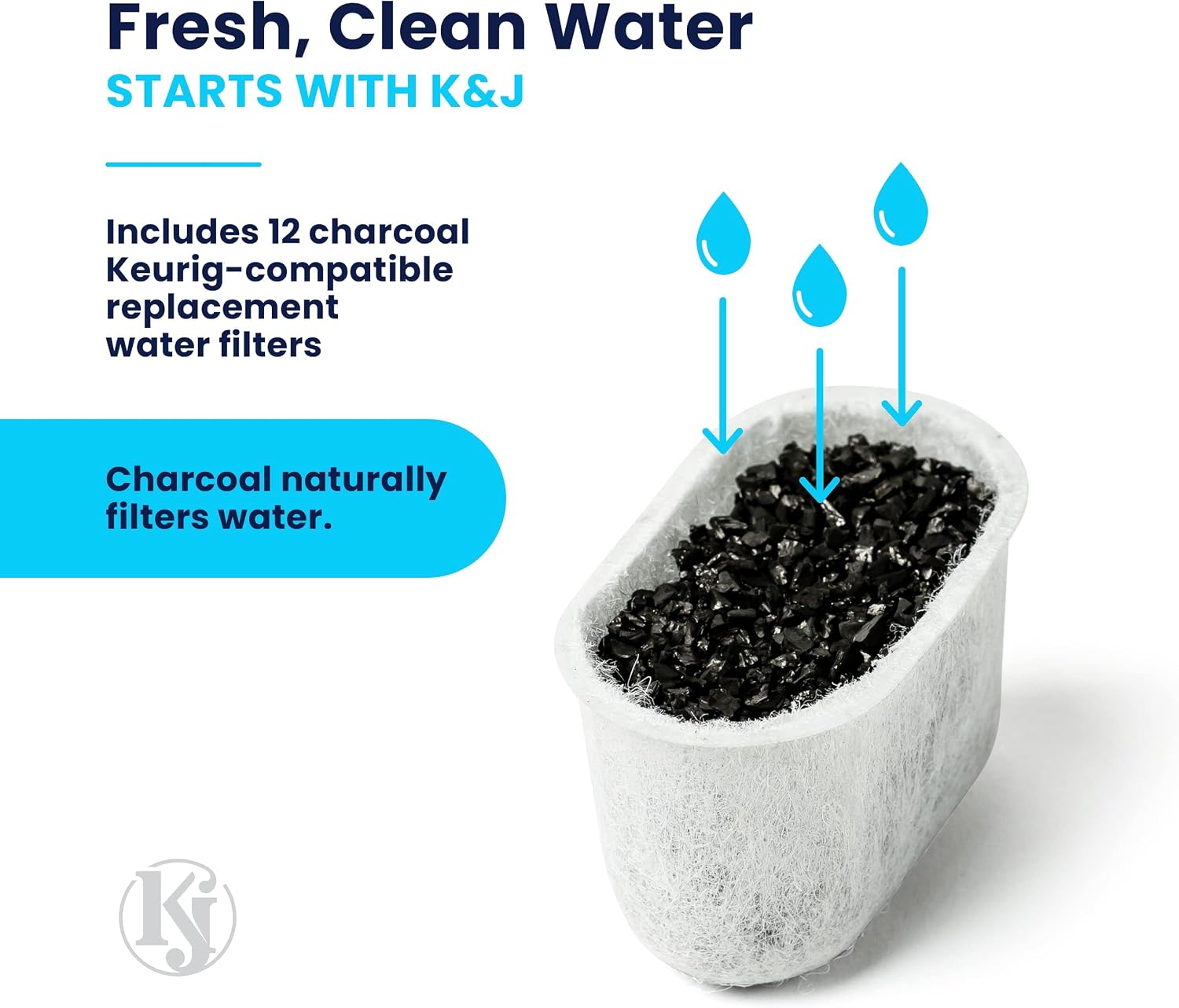
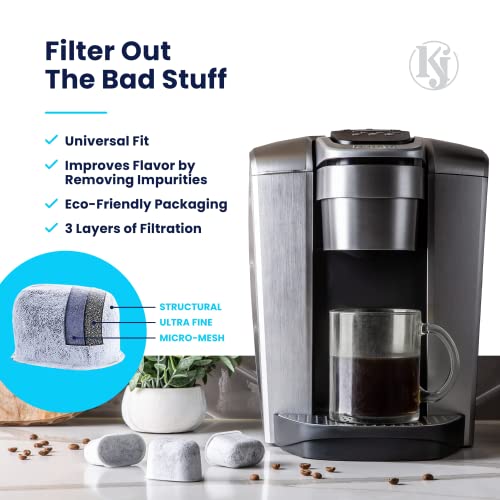
A Keurig water filter is a small charcoal cartridge that sits inside the water reservoir. It has one job: strip chlorine and off-flavours out of tap water before that water is heated. It does not soften your water, and it does not stop scale — that distinction is the single most misunderstood thing about these filters, and it is why brewers still need descaling on a separate schedule.
What most Keurig owners end up buying:

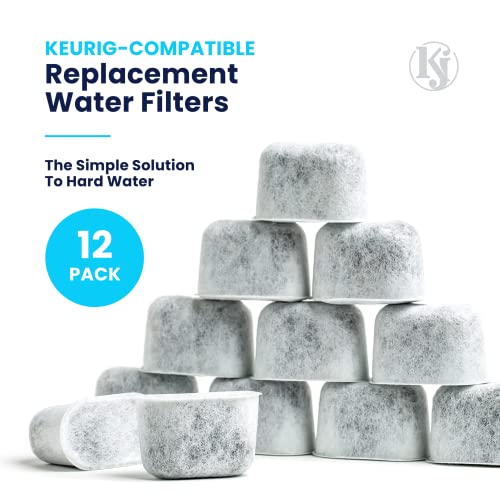
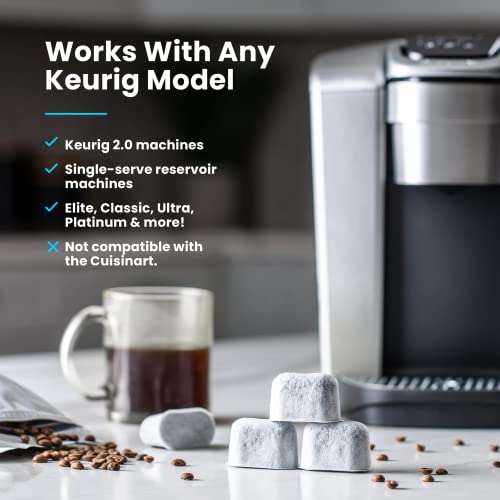
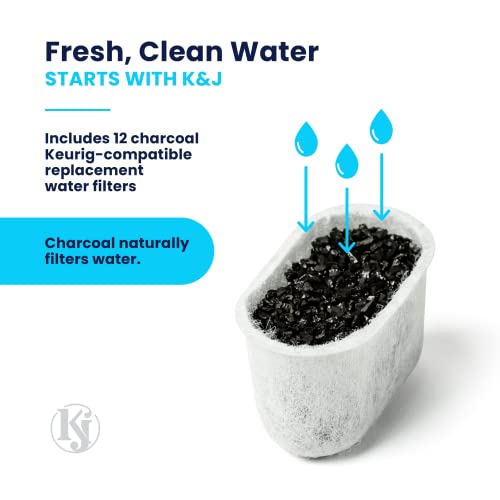
Prime 12 Pack Keurig Filter Replacement by K&J - Compatible with Keurig Coffee Machine (2.0 and older)




As an Amazon Associate we earn from qualifying purchases. Product prices and availability are accurate as of the date/time indicated.
Which Keurig models actually take a water filter
This is the first thing to settle, because a large share of Keurig owners are shopping for a filter their brewer cannot hold. The compact models were designed without a filter assembly at all — there is no holder, no slot, and nothing to retrofit. The fitment table above lists what we have verified; if your model is not on it, look inside the reservoir before you buy. A brewer that takes a filter has a visible plastic post or clip on the reservoir floor, or a lid-mounted holder.
Where a holder does exist, the cartridge itself is the same commodity part across the full-size range. That is why a 12-pack of third-party filters is sold as fitting a long list of models at once — the cartridge is standardised, only the holder differs.
Genuine Keurig refills or third-party filters?
Both work. The difference is price per filter, not performance you can taste.
- Keurig-branded refill cartridges — the safest choice if you want the part the manufacturer specifies, and the one to pick if your holder is fussy about cartridge height.
- Third-party 12-packs — typically a third to a half of the per-filter cost. The well-reviewed ones (tens of thousands of ratings) are dimensionally identical.
Run the maths before choosing: at a two-month change interval you need six filters a year. A 12-pack is a two-year supply, so the pack size matters more than the sticker price.
How often to change it
The widely published guidance is every two months, or about 60 tank refills, whichever comes first. Two things shift that number:
- Hard water loads the cartridge faster. If you already descale more often than the manual suggests, shorten the filter interval too.
- Low usage is not a reason to stretch it. A damp charcoal cartridge sitting in a reservoir for six months is a place for biofilm to grow, not a filter that is still working.
Changing the cartridge
The procedure takes about five minutes and needs no tools.
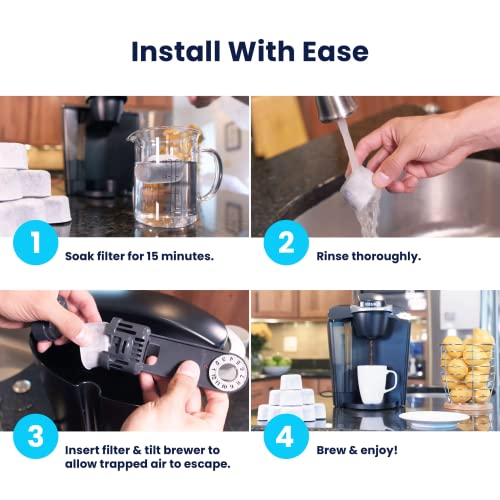
- Soak the new cartridge. Submerge it in a cup of water for five minutes. This purges trapped air so the charcoal wets through evenly.
- Rinse it. Hold it under running water for around a minute to wash out loose carbon dust. Skipping this is why some people see black specks in the first cup.
- Open the holder. Pull the assembly out of the reservoir and separate the two halves. Older cartridges can be stiff — twist rather than pull.
- Set the reminder dial. Most holders have a small dial marked with months. Turn it to two months from today so you are not guessing later.
- Reassemble and seat it. Push the holder back onto its post until it clicks. A holder that is not fully seated lets water bypass the filter entirely.
A filter is not a substitute for descaling
Charcoal adsorbs chlorine, sediment and taste compounds. Calcium and magnesium — the minerals that become scale on the heating element — pass straight through. A brewer running a fresh filter still scales up at the same rate. The two jobs are separate, and skipping the descale is what eventually produces a slow, half-full, sputtering brewer.
Common questions
If your brewer is making weak or short cups even with a fresh filter and a recent descale, the problem is more likely a blocked needle or the pump, not the water path.
More Keurig repair guides: every Keurig fix and part on this site.
What the filter actually changes in the cup
Municipal water is chlorinated, and chlorine survives heating. In a brewer that holds water at just below boiling for a few minutes, that chlorine has time to react with the coffee’s own compounds, and the result is a flat, faintly chemical edge that people usually blame on the beans. Activated charcoal adsorbs it before the water reaches the heater.
The difference is easiest to notice in two situations: light roasts, where there is no dark-roast bitterness to hide behind, and black coffee without milk. If you drink dark roast with milk and sugar, a filter is a marginal upgrade. If you buy single-origin beans and drink them black, it is one of the cheapest improvements available.
What it does not change is body, strength or extraction. A filter cannot rescue stale beans or a machine that is brewing short.
Hard water, soft water and how it moves the interval
Two months is the published guidance, and it assumes moderate water. Your own water should adjust it:
- Soft water — you can stretch to ten weeks without much penalty. The cartridge is doing less work.
- Hard water — six weeks is more realistic, and you will see scale on the heating element long before the filter is exhausted.
- Well water or heavily treated supply — check monthly. Sediment loads a charcoal cartridge much faster than dissolved minerals do.
The cheapest way to know which you have is a hardness test strip, sold in the same aisle as descaler. It costs a few dollars and settles both the filter interval and the descaling interval at once. Failing that, look at your kettle: a chalky white crust inside within a month means hard water.
Four mistakes that make a new filter useless
- Not soaking it. Dry charcoal traps air. Water then flows around the media rather than through it, and the cartridge does almost nothing until it wets through on its own — which can take weeks.
- Not rinsing it. Loose carbon dust ends up in the first few cups as black specks. A minute under the tap prevents it.
- Not seating the holder. If the assembly is not pushed fully onto its post, water takes the easier route around it. This is the single most common reason people say filters made no difference.
- Treating it as a descaling substitute. It is not one, and a brewer on a fresh filter scales at exactly the same rate as one without.
What it costs to run for a year
At a two-month interval you need six cartridges a year. Genuine refills work out around $2 each in a small pack; well-reviewed third-party 12-packs bring that closer to $0.70. So the yearly cost is roughly $12 at the top end and $4 at the bottom — less than a single bag of speciality beans either way.
Buying a 12-pack is the obvious move: it is a two-year supply, it removes the temptation to stretch the interval because you have run out, and the per-filter price is where the saving actually lives.
When the filter is not your problem
Three complaints get blamed on water filters and are caused by something else entirely:
- Bitter or burnt-tasting coffee — usually old coffee oils in the pod holder and around the exit needle, not water.
- Slow brewing or short cups — a partial blockage, most often at the needles.
- Coffee that is not hot enough — scale insulating the heating element, which is a descaling job.
Related on BrewerRepair: Keurig Water Reservoir Replacement.
Filters that fit
All three are the same standard cartridge. Choose on pack size and price per filter rather than brand.
12 Pack Keurig Filter Replacement by K&J - Compatible with Keurig Coffee Machine (2.0 and older)

Keurig Filter Replacement by Pureline, 12 Pack Charcoal Water Filter
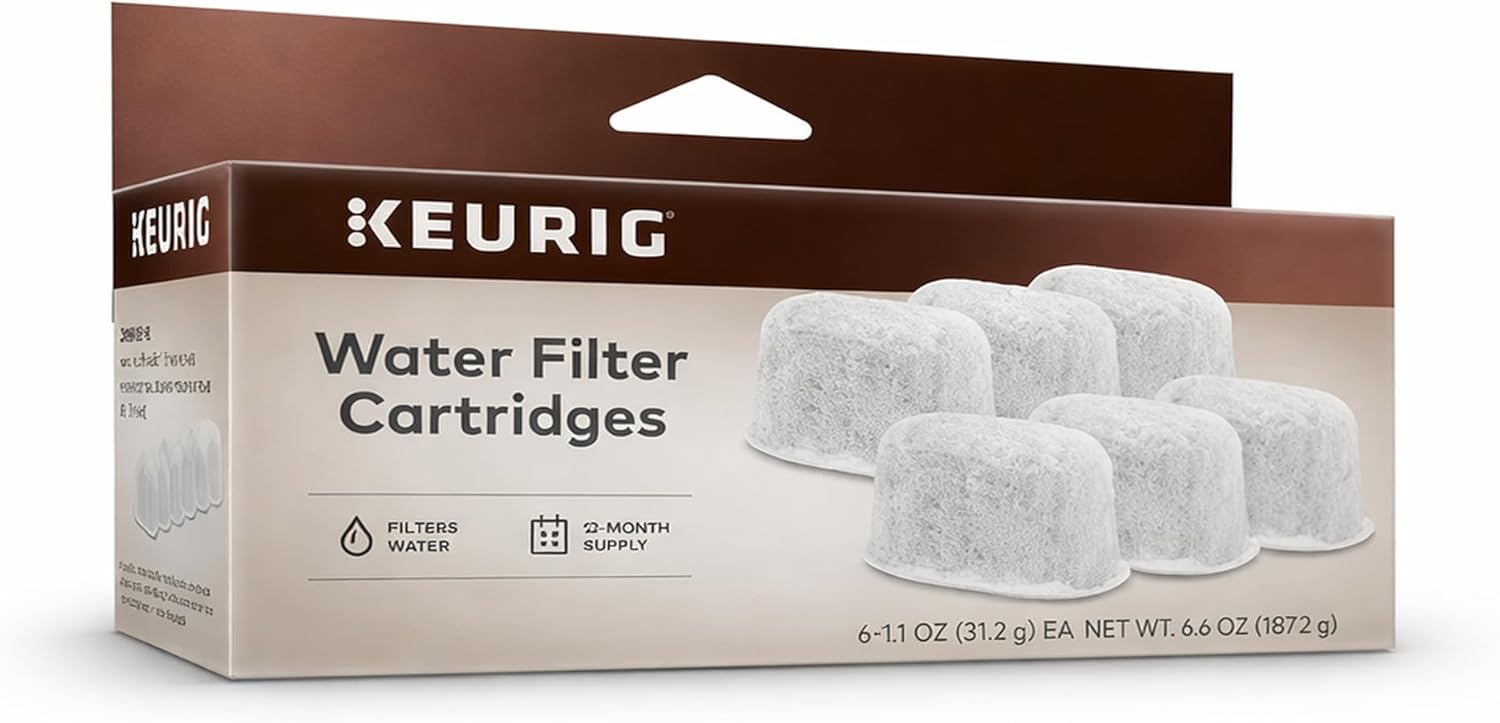
Keurig Water Filter Refill Cartridges, Replacement Water Filter Cartridges, Compatible with 2.0 K-Cup Pod Coffee Makers, 6 Count
Where to buy it
Keurig
Keurig Water Filters: Which Cartridge Fits and How Often
Paid link. Price shown is indicative — check the listing for the current price. We earn a commission at no extra cost to you.
Questions about this part
Does a Keurig water filter stop limescale?
No. Charcoal removes chlorine and taste compounds, not the calcium and magnesium that form scale. You still have to descale on a separate schedule.
How often should I change it?
Every two months, or about 60 tank refills. Shorten that in hard-water areas.
Do I have to soak the new filter first?
Yes, five minutes in water, then rinse it for about a minute. That removes loose carbon dust that would otherwise end up in your first cup.
Will a K-Mini take a filter?
No. There is no filter holder in a K-Mini reservoir and nothing to retrofit.
Are third-party filters as good as Keurig ones?
Dimensionally they are the same commodity cartridge. Buy on pack size and review count rather than brand.
Repairs that need this part
Keurig Coffee Tastes Burnt or Bitter: What Causes It
Burnt and bitter are different complaints with different causes, and the plastic in a Keurig holds onto old coffee oil in a way people underestimate.
Keurig All Lights Flashing: Keurig’s Own Fix Sequence
Add Water, Heat and Medium Cup flashing together is a water-delivery fault, not an electrical one. Keurig’s published four-step sequence, plus the two causes it leaves out.