Descaling Cuisinart Coffee Machine Models: The Cycle, and Why the Clean Light Stays On

Descaling Cuisinart coffee machine models is one cycle and two rinses, in that order, with the charcoal water filter pulled out before you start. Most of the complaints about this job are not about the descaler at all. They are about a Clean light that will not go out, and that light is a counter, not a sensor.
What descaling Cuisinart coffee machine models actually removes
Scale is dissolved mineral out of your tap water, mostly calcium and magnesium, that comes out of solution when the water is heated and plates itself onto the hot side of the machine. It lands on the heating element, in the aluminium tube that carries water up to the shower head, and in the one-way valve at the bottom of the reservoir. It is hard, it is chalky, and detergent does nothing to it. That is why descaling uses an acid rather than a soap.
What descaling does not touch is coffee oil. Oil is what builds up in the brew basket, on the shower head and inside a thermal carafe, and it is what makes coffee taste stale and bitter long before scale makes it taste weak. The two jobs use different chemistry and run on different schedules, so treat them as two separate jobs rather than one.
The symptom pattern is the useful part. Scale makes a machine slow, quiet at the wrong moments, and cool in the cup. Oil makes a machine taste bad while still brewing at full speed. If your Cuisinart brews a full carafe in the usual time but tastes harsh, descaling will disappoint you.
The Clean light is a counter, not a measurement
On the DCC drip range, the Clean button lights after a set number of brew cycles have run since the last completed clean. It is not sampling the water and it has no idea how hard your water is. Two consequences follow from that, and between them they explain most of the frustration with this machine.
First, the light can come on when the machine has almost no scale in it, because you happen to live somewhere with soft water. Second, and much more common, the machine can be badly scaled while the light is still off, because you brew large carafes infrequently. Judge by how the machine behaves, not by the light.
The other half of it is the reset. The light clears when a full clean cycle completes, not when you start one. If you interrupt the cycle, empty the reservoir mid-run, or switch the machine off at the wall part way through, the counter does not reset and the light is still there afterwards. People read that as a failed descale and run the whole thing again, when what failed was the finish.
Before you start: take the charcoal filter out
If your machine has a charcoal water filter in the reservoir, remove it before you put any descaler in. The filter is activated carbon whose job is to adsorb what is in the water, so running acid through it both neutralises some of the descaler and ruins the filter in one pass. Fit a fresh one afterwards, or refit the old one if it was recently changed. Our page on Cuisinart charcoal water filters covers which cartridge fits which reservoir and what the real replacement interval is.
Empty the carafe and the brew basket as well. Descaler running onto a bed of wet grounds gives you a basket of acidic sludge and nothing else. If the brew basket is stained or the lid no longer seals, that is a separate part and a separate job: see Cuisinart filter basket replacement.
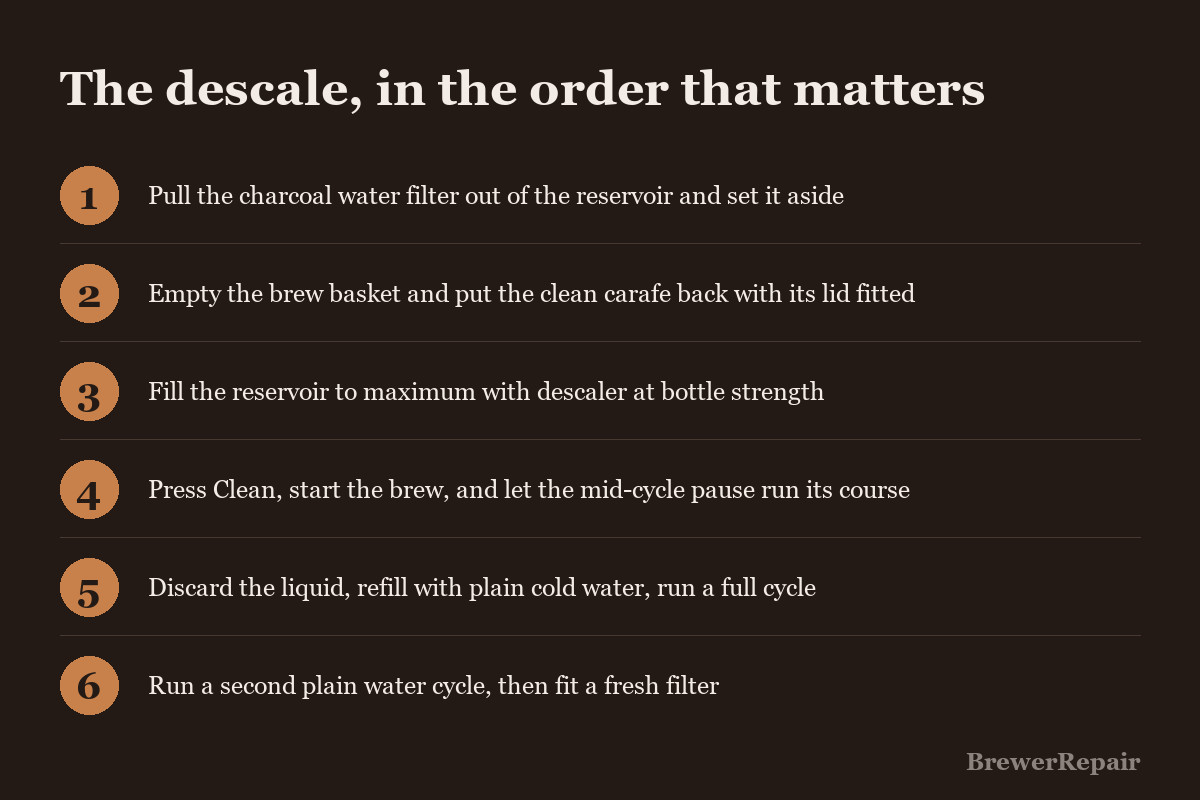
The cycle on a DCC drip machine
Fill the reservoir to its maximum line with descaling solution mixed at the strength on the bottle, or with the vinegar mix your model’s manual specifies. Put the empty carafe on the plate with the lid on, so the drip-stop stays open. Press the Clean button, then start the brew. The machine will pause partway through: that pause is deliberate and it is the part that does the work, because the acid needs contact time with the scale, not just contact.
Let it finish on its own. When the cycle ends, tip the carafe out, refill the reservoir with plain cold water, and run two full cycles through with no descaler in them. Two, not one. The second rinse is what stops the first coffee tasting of vinegar or of sharp descaler, and it is the step people skip.
On the question of which liquid to put in, that is genuinely a per-model answer and we keep it on its own page rather than repeating it here: Cuisinart descaling solution covers the vinegar mix, the branded solution, when aftermarket is fine and when it is not.
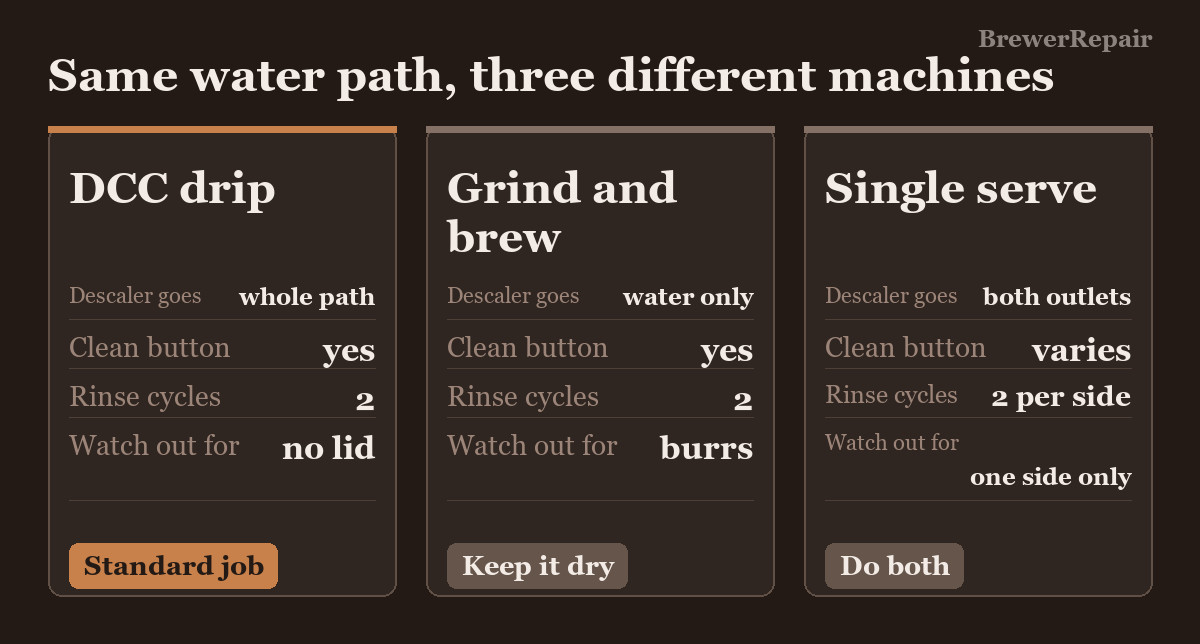
Grind and brew, single serve, and thermal carafe models
The water path is the same on all of them. What changes is everything the water path is attached to.
On a grind-and-brew, never put descaler anywhere near the grinder or the chute. Acid on burrs is rust, and wet coffee dust in a chute sets like grout. Descale the water side only, and clean the grinder dry. If the burrs are already suffering, Cuisinart burr grinder replacement is the part page for it, and if the grinder is the third thing to fail on the same machine, repair or replace on a Grind and Brew is the more honest question to ask.
On single-serve and combination machines, the pod side and the carafe side usually share one pump and one heater but not one outlet. Descaling only the side you use most leaves scale sitting in the branch you do not, and it comes back through the shared pump. Run the cycle so that solution passes out of both outlets.
Thermal carafe models need nothing acidic in the carafe itself. The carafe is a vacuum flask with a stainless liner and its problem is oil, not scale. If it has stopped holding heat, that is a seal failure rather than a cleaning failure, and Cuisinart carafe replacement covers matching a replacement to the brew head.
When the light will not clear, or comes straight back
Work through it in this order, because each step rules out the one after it.
Check that the cycle actually completed, with the reservoir holding enough liquid to finish. Confirm the carafe was on the plate with its lid fitted, because a drip-stop held shut by a missing lid stalls the run. Then look at whether the machine is still slow after the descale: a machine that clears the light but still brews slowly has scale further down than one pass can reach, and a second cycle with a longer stand is reasonable. Machines that have gone years without descaling sometimes need three.
If the light clears and returns after only a handful of brews, the counter is behaving normally and your brew volume is simply high. If the light never clears despite a complete cycle, the button or the board is the fault rather than the water path, and no amount of descaler will change it.
How often, and how to tell you are late
Every three months is the sensible default on ordinary municipal water. Monthly is not excessive on hard water, and twice a year is enough on genuinely soft water. Nobody can give you a number from your postcode alone, which is why the behaviour of the machine is a better guide than the calendar.
You are late when the brew time creeps up by more than a minute over what the machine used to do, when the last of the carafe comes through as a dribble, when the coffee is noticeably cooler than it was, or when the machine makes a new gurgling or straining noise near the end of the run. Any one of those on its own is worth a descale. Two together and you are well past due.
What descaling will not fix
Descaling is not a leak repair. Water on the counter under a Cuisinart comes from a cracked reservoir, a perished valve seal or a split hose, and acid will not seal any of them: Cuisinart coffee maker leaking from the bottom works through where to look. It will not fix bitter coffee from stale oil, it will not fix a machine that does not power on, and it will not rescue burrs that have already dulled.
It is also not a universal instruction. Cuisinart’s range runs from basic drip machines to espresso and super-automatic models, and the acceptable liquid and the cycle differ between them. If you are not certain which family yours belongs to, our guide to finding your model number is the fastest way to settle it before you pour anything in.
Common questions
Can I use white vinegar to descale a Cuisinart?
On many of the DCC drip machines, yes, and Cuisinart's own manuals for those models have long specified a mix of one part white vinegar to two parts water for the self-clean cycle. It is not a blanket answer across the whole range, and it is the wrong choice on espresso and super-automatic machines. Check the manual for your model family first.
Why is my Cuisinart Clean light still on after a clean cycle?
Because the counter resets on completion, not on start. An interrupted cycle, a reservoir that ran dry part way, or a machine switched off mid-run all leave the light where it was. Re-run the cycle and let it finish without touching it.
How many rinse cycles do I need after descaling?
Two full cycles of plain cold water, both run through and discarded. One rinse leaves enough acid behind to taste in the first pot, which is the usual reason people conclude that the descaler was too strong.
Do I have to remove the water filter before descaling?
Yes. The charcoal cartridge adsorbs what passes through it, so it both weakens the descaler and is itself spent by the acid. Take it out, run the job, then refit a fresh cartridge.
How often should a Cuisinart coffee maker be descaled?
Every three months on ordinary water, monthly on hard water, twice a year on soft water. Adjust by how the machine is behaving rather than by the Clean light, which counts brews and knows nothing about your water.
What happens if you skip it
These are the failures that scale causes, in the order we see them.
Breville Steam Wand Not Working: Blocked, Not Broken
A Breville steam wand that has stopped working is almost never broken. The holes in the tip are under a millimetre across, milk dries inside them…
De’Longhi Milk Frother Not Working: Blocked, Not Broken
Milk dries into a hard plug inside the frother path within hours. Almost every frother that has stopped working is blocked rather than faulty.
Bunn Coffee Maker Leaking: The Tank Is Always Full
Bunn machines hold a tank of hot water permanently, which is why they brew in three minutes and why a leak here behaves differently from any other brewer.